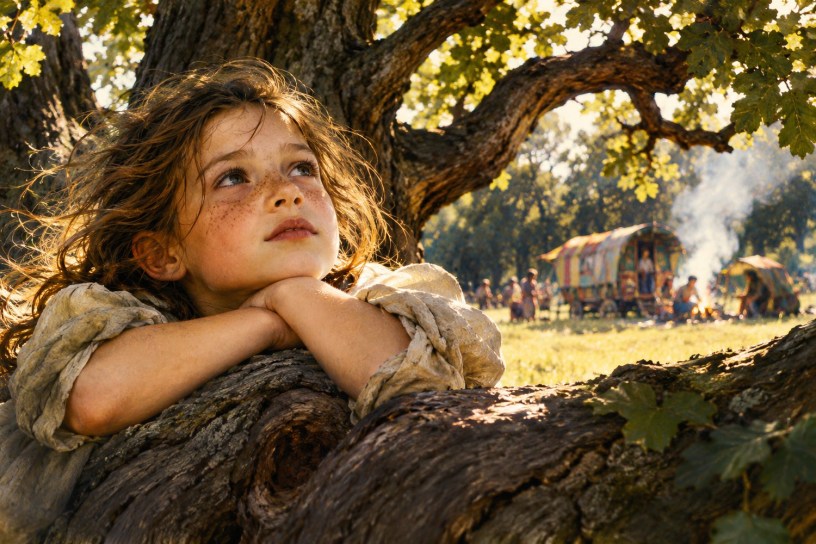
Author, Olga Ianaeva offers this story of a young girl who finds friendship, freedom and comfort among six ancient oak trees as the forest around them gives way to apartment buildings. Through childhood secrets, unexpected encounters and the pain of loss, she discovers how deeply a place can become part of us, and how its presence can endure in memory long after it has gone..
Suitable for all ages.
The Oaks
New five-story apartment buildings were springing up on the hill.
The forest was slowly disappearing from reality.
Only the old-timers from the neighboring village still told stories about forest animals and Gypsy encampments in the large clearings.
One clearing had survived.
It had been left untouched because of its fairy-tale appearance: six enormous oak trees formed a perfect circle.
How could the oaks have grown in such a perfect circle?
Perhaps they had agreed among themselves.
The oaks continued to live the life of the forest, unaware of the new buildings closing in around them.
My mother used to take me through this clearing on our way to and from kindergarten.
Later, when I started school, I walked this way on my own. This was the only route I took.
They were still there, those six giants, six living relics.
Each had a copper plaque bearing its age and scientific name.
The oaks were not identical twins.
Each had its own distinctive features.
One looked like a gigantic spider — my favorite of them all.
I would make wishes, and my spider-oak listened to me in a special way…
❦
The oaks’ roots bulged above the ground like enormous veins. You could walk from one to another, lie on them, read, and even do your homework.
The oaks watched me grow up, watched me laugh and cry, listened as I complained to them about the injustices in my young life.
Sometimes I would simply sit in silence, stroking their rough bark…
They sensed my moods and thoughts.
In that place, I was neither a schoolgirl nor someone’s daughter.
I could remain there, if only for a little while, free of labels, a nameless, invisible being.
One day, after school, I hurried to my giants.
Sitting in my place, on the lower branch of my spider-oak, was an old Gypsy woman in all her splendor: large earrings, necklaces, bracelets, a bright headscarf, and grey hair falling to her shoulders. The Gypsy woman sat with her eyes closed.
Her age had passed beyond the point where it was possible to tell.
Did the oaks remember her — bold, beautiful, young? Of course they did. Perhaps this had once been the place where she had loved…
The Gypsy woman beckoned to me with a dark, soot-stained finger.
My mother had taught me to be polite to adults. I approached, holding back my fear and my urge to run away.
The Gypsy woman narrowed her eyes, tapped me on the forehead with that finger, which smelled of mahorka tobacco, and hissed in a cracked voice:
“You know, your future is closed to me. And I could have told you, you know…”
Having lost all interest in me, the Gypsy woman turned sharply.
With a barely perceptible sway of her hips, perfected over decades of dancing, she brought her skirts to life — skirts the colors of earth, sand, and red clay. The skirts rippled, and I saw her bare feet, the same color as the earth itself…
The Gypsy woman strode away, her back straight — independent of our familiar way of life, unwilling to share her world or her destiny.
Perhaps the camp was preparing to move on, far away, and the Gypsy woman had come to say goodbye to the oaks.
So this place wasn’t mine alone.
The oaks were my secret. But what kind of secret is it if you can’t tell at least one person?
Not my classmates, though. And not the kids from the neighborhood. I wanted to find a new friend.
The boy’s name was Misha, but everyone called him Mickey. He was a grade ahead of me.
We were friends for a few days.
He would carry my schoolbag, and I shared my treasure with him—the secret of my oaks.
And then, quite naturally, our friendship faded.
That day, I was hurrying toward my secret spot.
Mickey was sitting next to one of the oaks.
“The oaks are mine,” he said, his voice harsh. “They’re mine now. Every single one of them. Go another way.”
I laughed. Loudly. Then even louder—and I just couldn’t stop.
It was like saying: the sky is mine now, and the sea is mine, too. Don’t look at the sky. Don’t swim in the sea…
I gave the thief who’d stolen my treasure a good, solid whack on the back with my schoolbag, then hurried home.
Once home, I crawled under the table. That was my secret hideaway. It was a round, wooden table. Beneath it, I felt safe. I often fell asleep right there. My mother never disturbed me.
Sit there, Mickey. Sit on my circle of oaks. Stay there for a hundred years. Let your beard grow gray and trail all the way to the ground, and don’t forget to keep that nasty look in your eyes.
Even behind the blackest clouds, the clear blue sky is always there.
You fool.
It seemed that the oaks never changed over the years. But, of course, that wasn’t true.
Early spring was raging. Tiny new leaves were appearing on the ancient giants…
Mickey had already finished school. He had enrolled in some kind of college.
I was hurrying to my own place.
Around the circle, gaping holes remained in the ground. The air smelled of fresh-cut wood, and enormous branches lay scattered everywhere.
The oaks were gone.
It was beginning to grow dark and cold.
I picked up a little branch from my favorite spider-oak. A branch with delicate green leaves.
There was so much joy in them, so many plans…
For some reason, I tucked the branch inside my jacket to keep it warm, like a kitten.
I sat for a long time with the branch on a bench outside our building.
Our neighbor’s little girl, Ira, appeared on the porch. She was still in kindergarten.
“Ira, do you have a little shovel at home?”
Ira gave the question some serious thought and answered solemnly:
“No.”
“Then bring me a tablespoon. And make sure no one notices.”
I planted the little branch beneath our balcony. Then I returned the spoon to Ira.
“Have you been eating dirt?” Ira asked in astonishment.
She was sitting on the bench, although she wanted to follow me. But her mother had strictly told her to sit and wait. Ira was wearing her best dress, and they were getting ready to visit someone.
At home, I crawled under the table to hide my pain beneath the blanket. I closed my eyes.
The oaks stood before me, alive. Then I heard the sound of a saw. They were cutting them down, and the oaks were crying out, clinging to one another with their branches, saying goodbye…
I tried to cry silently beneath the blanket. By morning, my throat had swollen, and I refused to eat.
My mother decided I was ill and let me stay home.
I lay beneath the table, but I was there, among the living oaks with their green leaves.
And suddenly I noticed: my table was round and wooden. And the circle of oaks? Now I understood why I had chosen my favorite place in the house, beneath that table.
For two years, I couldn’t bring myself to go near the place where the oaks had died.
One day, I finally summoned the courage.
A bright children’s playground had been built there, made entirely of wood from the fallen oaks.
The same Gypsy woman again! How old could she be now?
So the camp had returned.
The Gypsy woman sat on a bench, as if dozing.
Her face, darkened by nearly a century of sun, had grown thinner, her features sharper.
She noticed me but didn’t recognize me.
She gave me a piercing look.
She shook her finger at me — the very same finger she had tapped against my forehead.
Suddenly I understood: her eyesight was failing. My outline was blurred to her. She wasn’t shaking her finger at me, but at my silhouette, which she could no longer make out…
The Gypsy woman rose swiftly and strode confidently along the familiar paths. Her feet remembered better than her eyes. She walked with her back straight, her earth-colored skirts billowing…
Invisible, yet faithful, Eternity had absorbed all our times. It holds the time of the oaks, the Gypsy woman’s century — and my childhood…
Text and Image © Olga Ianaeva 2026
Olga Ianaeva
Olga Ianaeva is a writer, director and screenwriter from Ukraine, currently living in Georgia.
When I write, I often recall Leonardo da Vinci’s sense of mystery—a quiet depth that reveals itself gradually. I try to bring the same light, almost transparent depth to my stories, where a person’s inner life becomes visible through small details.

